Introduction
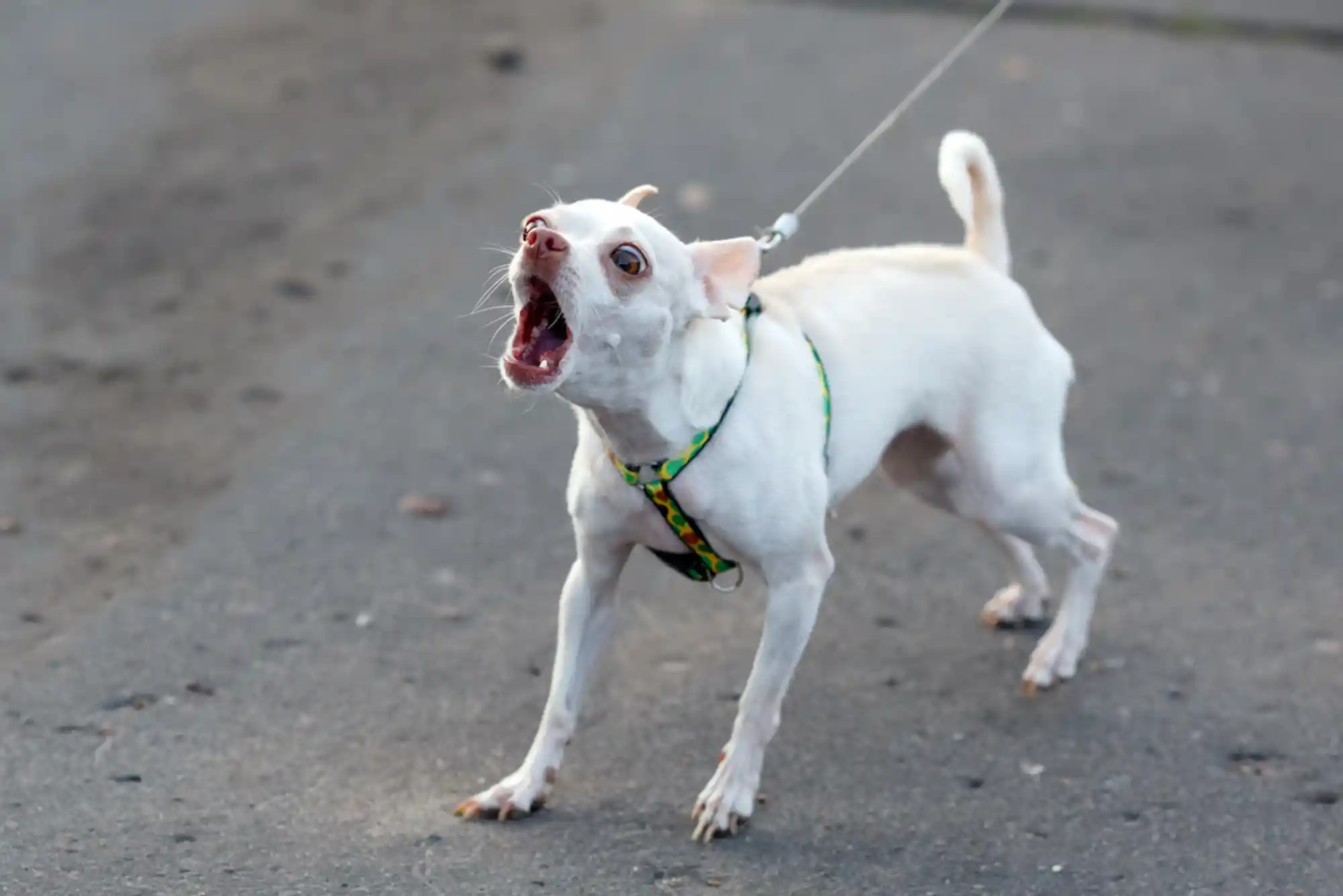
Walking should be one of the easiest ways to spend quality time with your dog. Yet when you have a dog barking at other dogs on leash, even a short walk can become stressful. Your dog may bark, lunge, growl, stare intensely, pull toward another dog, or spin at the end of the leash. You may feel embarrassed, frustrated, or unsure about what to do next.
The good news is that leash reactivity is not simply a matter of having a “bad” or disobedient dog. Dogs may react because they are frightened, frustrated, overexcited, uncomfortable, or unsure how to respond when another dog approaches. The goal is not merely to silence the barking. The goal is to change the emotional response behind it and teach your dog a safer alternative.
A dog barking at other dogs on leash can improve significantly with careful management, appropriate distance, reward-based training, and consistency. Veterinary behavior professionals commonly recommend management alongside gradual behavior modification because repeatedly allowing a dog to become overwhelmed can interfere with training progress.
What Does Leash Reactivity Actually Mean?
Leash reactivity describes an exaggerated response to a particular trigger. In this case, the trigger is usually another dog.
A dog barking at other dogs on leash may appear aggressive, but barking alone does not tell you exactly what the dog is feeling. Some dogs bark because they are scared and want the other dog to move away. Others are frustrated because the leash prevents them from approaching. Some become highly excited when they see another dog.
Body language provides important clues. A fearful dog may crouch, tuck its tail, lean away, lick its lips, or attempt to escape. A frustrated dog may lean forward, pull strongly, whine, and bark while maintaining intense visual focus.

Understanding the reason behind the reaction matters because training should address the underlying emotion rather than simply suppressing the visible behavior.
Why Does My Dog Bark at Other Dogs on Leash?
There is rarely one explanation for a dog barking at other dogs on leash. Several factors can contribute.
Fear and Anxiety
Some dogs learn that barking makes another dog move away. From the dog’s perspective, barking works. If the approaching dog continues walking away, the reactive dog may become more convinced that barking is the correct response.
This is especially common in dogs that have had frightening experiences with unfamiliar dogs.
Frustration and Excitement
Not every reactive dog is afraid. Some dogs desperately want to greet another dog but become frustrated when the leash prevents them from reaching it.
The result can look remarkably similar: pulling, barking, whining, jumping, and intense staring.
Previous Experiences
A single unpleasant interaction can influence future behavior. A dog that was attacked, cornered, repeatedly overwhelmed, or poorly socialized may become more sensitive around unfamiliar dogs.
However, you should not automatically assume that every reactive dog has experienced trauma. Genetics, temperament, learning history, environment, and individual personality can all influence behavior.
The First Rule: Stop Practicing the Reaction
One of the most important parts of helping a dog barking at other dogs on leash is preventing unnecessary rehearsals of the behavior.
Every time your dog repeatedly explodes at another dog, that pattern can become more established. This does not mean you have to stop walking forever. Instead, temporarily make walks easier.
Choose quieter routes or times when fewer dogs are present. Cross the street when necessary. Use parked cars, fences, or other visual barriers to create space. If your dog cannot cope with a particular environment, provide exercise and enrichment at home while you work on the behavior.
Management is not failure. It gives your dog fewer opportunities to practice the unwanted response while you build better skills. AVSAB specifically recommends management for reactive dogs alongside training.
Find Your Dog’s Reaction Distance
Distance is one of your most powerful training tools.
Imagine your dog notices another dog from 100 feet away but remains relaxed. At 70 feet, your dog becomes alert but can still eat treats and respond to you. At 40 feet, your dog begins barking and lunging.
The 40-foot distance is too difficult for training at this stage. The 70-foot distance may be a useful starting point.
This is commonly called working below threshold. Your dog needs enough emotional space to notice the trigger without becoming overwhelmed.
If your dog barking at other dogs on leash cannot take food, respond to its name, look away from the other dog, or move with you, you are probably too close.
Start the Reactivity Protocol
The basic protocol combines desensitization and counter-conditioning. In simple terms, you expose your dog to the trigger at a manageable intensity while pairing the trigger with something your dog loves.
Step One: Identify the Trigger
Begin by observing exactly what causes the reaction.
Does your dog react to every dog? Only large dogs? Only dogs approaching head-on? Only dogs that stare? Only dogs that are running?
Knowing the pattern allows you to create controlled training situations rather than exposing your dog randomly.
Step Two: Start Far Away
Position yourself far enough from another dog that your dog can remain under control.
The instant your dog notices the other dog, calmly mark the moment with a word such as “yes” and give a high-value treat.
You are teaching an important association:
“Dog appears, good things happen.”
Do not wait until barking begins. The reward should arrive while your dog is still capable of thinking.
Step Three: Reward Calm Observation
If your dog looks at another dog and then looks back at you, that is valuable behavior.
Reward it.
If your dog chooses to sniff the ground, turn its head away, walk with you, or remain relaxed while another dog passes, reward those choices too.
Over time, you want your dog to learn that calmly noticing another dog is more rewarding than exploding at it.
Research-informed veterinary behavior guidance supports reward-based training and advises against methods involving pain, fear, leash corrections, or aversive equipment.
Step Four: Gradually Decrease Distance
Do not rush this stage.
If your dog can calmly watch another dog from 70 feet away during several sessions, you might eventually work at 65 feet. Then perhaps 60 feet.
The progression should be based on your dog’s behavior rather than an arbitrary schedule.
If your dog barking at other dogs on leash suddenly starts reacting again, increase the distance. Moving away is not giving in. It is helping your dog recover.
Teach an Emergency U-Turn
A U-turn can be one of the most useful practical skills for leash-reactive dogs.
Teach it at home first. Say a cheerful phrase such as “this way,” turn around, and encourage your dog to follow you. Reward the dog for coming with you.
Practice in quiet outdoor areas before using it around triggers.
When another dog unexpectedly appears too close, you can turn and create distance before your dog reaches the point of barking.
This is particularly important because training will not always happen under perfect conditions. Real walks involve narrow sidewalks, loose dogs, unexpected encounters, and people who do not understand your dog’s needs.
Do Not Force Your Dog to Say Hello
A common mistake is assuming that a dog needs to greet every dog it sees.
It does not.
A dog can have a perfectly healthy, enjoyable life without greeting unfamiliar dogs on every walk. In fact, some dogs are happier when they have predictable space around them.
If another owner says, “Don’t worry, my dog is friendly,” you are still allowed to create distance.
Your dog’s comfort matters more than completing a social interaction.
What to Do When Your Dog Starts Barking
Even with good preparation, mistakes will happen. Perhaps another dog suddenly appears around a corner and your dog begins barking.
Do not punish the reaction.
Instead, calmly create distance. Use your practiced U-turn, move behind a parked car, cross the road, or walk into a driveway or quiet area if it is safe to do so.
Once your dog can think again, offer reinforcement for calm behavior.
Trying to force a reactive dog to remain close to its trigger can increase stress and make future reactions more difficult. Management helps prevent these repeated overwhelming experiences.
Choose the Right Rewards
For many dogs, ordinary kibble is not enough when another dog appears nearby.
Experiment with highly motivating food such as small pieces of cooked chicken, cheese, or another food your dog safely enjoys. The reward should be tiny because you may deliver many pieces during a training session.
Remember that reinforcement is individual. What is highly rewarding to one dog may be uninteresting to another. Even the same reward can become less effective when a dog is highly aroused.
The goal is not to bribe your dog forever. You are using reinforcement to help establish a new emotional and behavioral pattern.
Keep Training Sessions Short
Reactive-dog training can be mentally exhausting.
Instead of attempting a long walk filled with triggers, aim for short, successful practice sessions. Five calm repetitions can be more useful than thirty stressful encounters.
End the session while your dog is still doing well.
Progress is often uneven. One day your dog may calmly watch several dogs pass. The next day, a single barking dog may be too much. Weather, fatigue, pain, environment, distance, and previous stressful events can all affect behavior.
Look for trends over time rather than expecting perfection every day.
Avoid Punishment-Based Reactivity Training
When a dog is barking, it can be tempting to correct the behavior with a leash jerk, yelling, prong collar, choke chain, or shock collar.
However, punishment can suppress outward behavior without resolving the underlying emotion. It can also cause the dog to associate unpleasant experiences with the presence of other dogs.
AVSAB’s current position recommends reward-based training for behavior problems and advises against aversive methods, including leash corrections, prong collars, choke chains, and electronic collars.
For a dog barking at other dogs on leash, the better question is not “How do I punish the barking?” It is “How can I help my dog feel safe enough to respond differently?”
When Should You Get Professional Help?
Professional help is especially important if your dog has attempted to bite another dog, redirected aggression toward you, caused injury, cannot recover after encounters, or reacts at extremely large distances.
A veterinarian should also be involved when behavior changes suddenly or appears unusually intense. Pain and medical problems can influence behavior, so a sudden behavioral change should not automatically be treated as a training issue.
Look for a qualified professional who uses reward-based methods and has experience with canine reactivity. For severe cases, a veterinary behavior professional may be appropriate.
Getting help does not mean you have failed as a dog owner. Reactivity can be complicated, and having an experienced professional observe your dog can make the training process safer and more efficient.
How Long Does Leash Reactivity Training Take?
There is no universal timeline.
Some dogs show noticeable improvement within a few weeks. Others need several months of carefully managed training. Dogs with severe fear, extensive rehearsal of reactive behavior, or multiple triggers may require considerably more time.
Avoid trainers who promise to “fix” a reactive dog in a single session.
A realistic goal is steady improvement: greater reaction distance, faster recovery, more frequent check-ins with you, less intense barking, and an increasing ability to pass dogs without losing control.
The ultimate goal does not necessarily have to be making your dog love other dogs. A much more realistic and useful goal is helping your dog calmly notice another dog and continue walking.
A Practical Daily Routine for a Reactive Dog
Before leaving home, prepare your high-value rewards and choose a route that gives you room to move away from triggers.
During the walk, reward your dog for naturally checking in with you and calmly observing the environment. When another dog appears at a manageable distance, begin your counter-conditioning routine.
If the other dog comes too close, prioritize safety and create distance rather than trying to complete a training exercise.
After the walk, give your dog an opportunity to decompress. Sniffing, chewing, food puzzles, and quiet rest can provide useful enrichment without adding more stressful exposure.
Consistency matters more than marathon training sessions.
The Real Goal of Stopping Leash Barking
When working with a dog barking at other dogs on leash, success is not simply measured by silence.
A dog that stops barking because it has become frightened of being corrected has not necessarily improved.
A dog that sees another dog, remains emotionally comfortable, looks toward its handler, accepts a treat, and continues walking has made meaningful progress.
That distinction is important.
Behavior modification should help your dog feel safer and give you practical skills for managing real-world situations. Over time, the barking may decrease because your dog no longer feels the same need to react.
Help Your Dog Learn That Other Dogs Are Safe
Learning how to stop a dog barking at other dogs on leash requires patience, careful management, and a willingness to work at your dog’s pace. Start by identifying your dog’s triggers and reaction distance. Prevent unnecessary close encounters, reward calm behavior, teach an emergency U-turn, and gradually introduce more challenging situations.
Most importantly, do not judge progress by one perfect walk. Reactivity changes through repeated experiences, and setbacks are normal.
If your dog continues to struggle, work with a qualified reward-based trainer or veterinary behavior professional. With the right plan, your walks can become calmer, safer, and much more enjoyable for both of you.
Ready to change your dog’s walks? Start with one simple goal today: find the distance where your dog can notice another dog without reacting, then reward every calm response. Small successful repetitions are the foundation of lasting behavior change.
FAQs
Why does my dog bark at other dogs when on a leash?
A dog may bark at other dogs because of fear, anxiety, frustration, excitement, or a learned response. Leashes can make the situation more difficult because the dog cannot freely move away or approach. Identifying the emotional reason behind the behavior helps determine the most appropriate training approach.
How do I stop my dog from barking and lunging at other dogs?
Start by creating more distance from other dogs and work below your dog’s reaction threshold. Reward your dog for calmly noticing another dog and then gradually decrease the distance as your dog’s skills improve. If your dog becomes overwhelmed, move farther away rather than forcing the interaction.
Should I ignore my dog barking at other dogs?
Simply ignoring the barking usually is not enough. If your dog is reacting because of fear or frustration, you need to change the situation and teach an alternative response. Creating distance and rewarding calm behavior are generally more useful than waiting for the barking to stop on its own.
How do I train my dog to ignore other dogs on walks?
Begin at a distance where your dog can see another dog without reacting. Reward your dog for looking calmly and checking back with you. With repeated successful sessions, gradually work closer. The goal is not necessarily to make your dog completely ignore other dogs, but to teach your dog that calmly passing them is safe and rewarding.
Should I let my reactive dog greet other dogs?
Not necessarily. Many reactive dogs benefit from avoiding forced greetings, particularly while behavior modification is underway. Your dog can learn to calmly pass other dogs without interacting with them. Controlled interactions with appropriate dogs can be considered separately when your dog’s behavior and emotional state make them safe and beneficial.
Can leash reactivity be cured?
Leash reactivity can often be significantly improved, but there is no guaranteed cure or universal timeline. Some dogs may eventually pass other dogs calmly, while others may always need additional space or management. The objective is to improve safety, emotional comfort, and the dog’s ability to function successfully around triggers.